
Dramatis Personae
The choice of sub-heading is very appropriate, since the four main characters of this little adventure share theatrical roots to varying degrees. We all attended Croydon Secondary Technical School in the mid-1960s and early 1970s. We were members of a theatre group there (“Group 4”) and also part of CYTO (Croydon Youth Theatre Organisation). I think my role in both was rather peripheral. Trev and Paul were also involved with Croydon Operatic Society.
We all took separate paths through life and met up for a little reunion in 2024 after 40 years of not seeing each other. Paul, Trev, Rob and I went to Loughborough on that occasion. My three friends have an additional bond through their love of steam trains and Loughborough has strong links with the age of steam. While I can appreciate their enthusiasm, it is not something that has ever lit my firebox.
We met again the following year, this time in Leicester. It was then that we decided we should go back to where it all began for this year’s reunion. Hence the trip to Croydon.
Act I – A Stroll before Lunch
The Set:
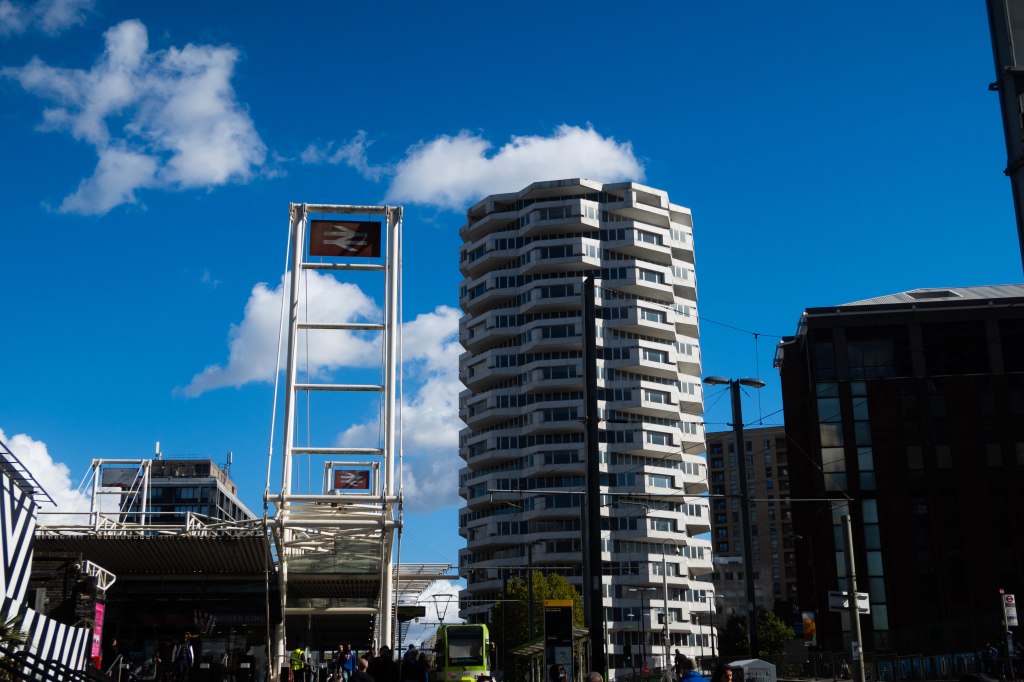
Imagine an urban landscape comprising a patchwork of modern high-rise buildings; sites of dereliction; brutalist architecture that has to be preserved but needs attention; the Fairfield Halls and Ashcroft Theatre; East Croydon Station; Katharine Street with the Victorian Town Hall and Clock Tower; a building adorned with a vibrant mural; a matrix of tram tracks; an iron gateway declaring “Surrey Street Market” and inviting you to step back in time; a pub once called The Dog and Bull now minus the bull, with an enclosed garden from where you can see chimney pots, slate roofs and the large sign of “Grants” which used to be a major department store; a bus-stop on Brighton Road; a bus ride, during which we pass old pubs that have been repurposed (The Swan and Sugar Loaf is now a Tesco Express, The Red Deer is now an Asian restaurant), businesses and shops in buildings that once had different businesses and shops; arriving at a pub which used to be The Windsor Castle on Brighton Road in South Croydon but is now a Toby Carvery.
Lighting:
Blue sky, a few white clouds, and bright sunshine.
Action:
We came from Leeds, we came from Sheffield, we came from Lewes, and one even came from Kettering, to meet at East Croydon Station. It was the station of my childhood, the start of journeys to London, to my grandparents’ in Sussex (“Change at Haywards Heath!”), and of course to Brighton, being the famous “Number 9 – the Brighton Line” in Bingo. I remember the huge steam locomotives, the wave from the driver with grimy face and peaked cap. The train passed through South Croydon, where we could look down the embankment to see the back garden and home of my paternal grandparents in Bynes Road. [Aside: I remember how their house used to shake every few minutes as the trains rumbled by].
If ever a place has changed, then East Croydon station certainly has. The charm of the old station has given way to a large modern complex, bustling with people. Yet, and this is a theme I will return to, it retains an essential core of how it used to be. I liken it to an organic process, similar to the growth of a coral reef – a foundation with an ever-changing outer appearance.
We headed across the main road, careful to avoid the trams, to view the old Croydon Technical and Art Colleges (not to be confused with our school – more later). Some of the buildings were still in use while others lay dormant. This is some of the brutalist architecture I mentioned earlier. There was a large area of derelict land nearby where once had stood a multi-storey car park. In the same area, we saw new high rise residential blocks reaching up to 163 metres in height.
We then went to the Fairfield Halls and took a wander into the foyer. This evoked a whole range of memories and feelings for us Gallant Four, each lost in our own recollections. We all remembered the school speech days that were held here. I once won the class prize for Endeavour – I was not really good at anything, but at least I tried hard!
I remember seeing a fair number of bands here, including Pink Floyd, Lindisfarne, The Nice (and later, Emerson, Lake and Palmer), Genesis (when it was fronted by Peter Gabriel), and King Crimson. It was strange to stand at the entrance and think that I was once a teenager there. Where have those years gone?
“Ah, but I was so much older then,
I’m younger than that now”
[Bob Dylan, “My Back Pages”, covered by The Nice]
Opposite The Fairfield Halls you can see the once imposing Nestlé Tower, the one-time European headquarters of the eponymous owners and now a partially stripped out eyesore caught in a tangle regarding its development into residential apartments. The lower part of the building was once The Greyhound bar and concert venue, where I saw yet more bands – definitely Thin Lizzy, and possibly Uriah Heep and Hawkwind. My memory of those times has become fragmented, but as friends of old together we can share the diverse threads of our memories and recapture at least the feelings, if not the precise details, of those distant times.
We took the steps down to the Town Hall gardens, once the site of Croydon Central Railway station. We emerged on Katharine Street to see the old war memorial that moved me as a young child (depicting soldiers bandaging their wounds) and the splendour of the Town Hall and Clock Tower in the sunshine, the red Wrotham bricks of this Victorian building contrasting with the white Portland stone dressings. The opposite side of the street is fenced off, with a large plot of derelict land behind.
At the end of the street we turned left and crossed over to Surrey Street Market. This is a timeless corner of the town, with the colour, noise and smells it has always had, allbeit now in modern dress and with stalls and shops that were not there in my childhood, and with vegetables that I didn’t even recognise. I remember an old corner shop that sold loads of second-hand hardware, greasy tools with varying degrees of rust and an impressive array of knives in the window.
Time for refreshments. We had some beer in the garden of the The Dog and shared a few more memories.
We headed to the bus-stop on Brighton Road and took the bus to South Croydon. What used to be The Windsor Castle often saw our younger selves as six-formers enjoying a lunchtime cider and a rowdy game of darts. Suitably nourished with more beer and the prandial offerings of Toby Carvery, we set out to retrace those steps of old back to the school.
Act II – An Ascent and a Descent
The Set:
Imagine a road with a gentle bend; a flight of concrete steps with a central railing for support; mixed residential homes, some new, some old; iron railings, leaves, gates and low walls; a new housing estate with a curious resident looking warily at the Gallant Four, straight out of an episode of Last of the Summer Wine; a park with old characterful trees and a fenced off play area; an old church finished in flint; another bus-stop; a ride on the top deck of a bus back into town.
Lighting:
As before, but starting to fade as late afternoon and evening approach.
Action:
The uphill climb, partly via a flight of steps, was a bit steeper and harder than I remembered, but this was probably because today’s body is not as able as it was. Trev had “fond” memories of dragging his double bass up and down this route on many occasions. I said he should have opted for the flute or violin. I vividly remembered the corner at the Brighton Road end where the bus stop was for getting back into town. I stood there many a winter’s evening in the cold waiting for the bus, and it even features as one of my recurring dreams. School finished at 16.00 so it was dark by the time we reached the bus stop in winter.
The views on the walk were also different, but this was an objective observation – new residential properties had been built. Some of the old railings remained, with fallen leaves on the path, but it was not as narrow as I remembered.
And so to school. We emerged onto Pampisford Road to see large white metal gates, but they were smaller than before and not the original entrance to the school. We imagined the large open gates leading to the main entrance to the school (another recurring dream – I have more repeats than the BBC). We knew the school had been demolished, but the experience of seeing the site now with all these new homes was strangely sad.
We walked along the road, trying to imagine where the old classrooms and workshops were located. Again, for each of us, different collections of memories and feelings were evoked. For some, the joys of the workshops, but not for me. I really was a square peg in a round hole with my incompetence in all things practical. I doubt I could ever make a square peg or a round hole. My technical drawings always ended up smudged and not very technical. My efforts in woodwork and metalwork did not work at all.
A portion of the wall along the pavement looked as though it might have been part of the original. We discussed attaching a blue plaque to commemorate our time at the school. A nice idea, but if we wanted it straight then I would not be the one to wield the drill.
It was time to say goodbye to our old school again. We probably did not appreciate at the time how fortunate we were to have attended there. It was an all-boys school of around 400 pupils until it merged with the secondary modern school down the road towards the end of our stay there to become Haling Manor High School. First year pupils had to wear short trousers all year. Everyone had to wear their caps and blazers from doorstep to doorstep. We had to play football in snow and rain, an icy wind whipping across the playing fields, In summer lunch breaks on the fields, we would play Newmarket (a card game) for pennies and burn holes in our ties with magnifying glasses. I still have the evidence.
The teachers we had were absolutely dedicated to their profession. They were characterful and had their idiosyncracies. Only in later life did we realise some of them had served during the Second World War. I suppose the best descriptor is “traditional” with a good dollop of compassion.
The walk back to Brighton Road took us through Haling Park. I had no memory of this place but my friends recalled the many times they had been there. We passed the old church of St Augustine and then hopped on a bus to take us back into town, seeing the same shops and businesses as earlier, but in reverse.
Act III – A Retail Tour and Tales Retold
The Set:
Imagine a wide street lined on one side with old office blocks and newly converted residential buildings; an underpass passing under in the middle for no obvious reason; the entrance to a large covered shopping complex that is no longer a shopping complex; walkways, lifts, ramps and stairs connecting shops that are no longer there; exiting to a broad pedestrianised street lined with vibrant shops and businesses; large posters extolling the wonders of Croydon and plans for future improvements; the multi-cultural vibe of people going about their business; a view of Broad Green just ahead; a traffic-light controlled junction with a view over Wandle Park; trams on their tracks; the Clock Tower against an evening sky; alms houses on the corner of George Street; the welcoming sight of the pub sign for The Spread Eagle at the end of Katharine street.
Lighting:
Natural light fading, fading; neon lighting awakening; but still a warmth in the colours.
Action:
We got off the bus on Wellesley Road. I remembered that I used to work in one of the converted office blocks across the street many years ago. Now we were about to enter the Whitgift Centre, once the largest covered shopping development in Greater London for nearly 40 years, but now a skeleton.
It was sad to see all the empty shops, the ramps and pathways connecting empty spaces like the set from a post-apocalyptic film. At its heart used to be The Forum, a very popular pub and meeting place which I had the pleasure to visit on many occasions. I remember the lower level boasted a German-style bier keller -probably a long way from the real thing, but that did not stop me from taking some German friends there. Auf deine Gesundheit!
I used to have a Saturday and vacation job at the adjacent Woolworth’s store. I worked in the store room, on the fruit and vegetable counter, and on the fish counter. That lingering smell of fish did not do me any favours when I went out to socialise straight from work!
I also used to work at British Home Stores and Debenhams. I sense a theme emerging here. I think I have the Uncle Albert syndrome from Only Fools and Horses. Every ship he sailed on sank. My school has been demolished, those stores are no longer in existence, the office block I worked in is now flats, and the hospital where I did my nurse training has been demolished. Just call me Derek Jonah Lee.
The far end of the Whitgift Centre opens on to North End. This used to be a two-way street, busy with traffic and lines of buses (you know they have to travel in groups of three). Now, it is pedestrianised and looks wider. It looked to be thriving, people flowing in both directions with their shopping bags and other accessories, a definite multi-cultural feel, a definite vibe, a place that is alive.
We walked to the end of the pedestrianised zone, with a view over Wandle Park, and then retraced our steps. We passed the Whitgift Alms Houses on the corner of George Street, looking mellow in the early evening light, took another look at the Town Hall in the same light, and then gratefully retired to The Spread Eagle at the end of Katharine Street for final sustenance and the sharing of tales.
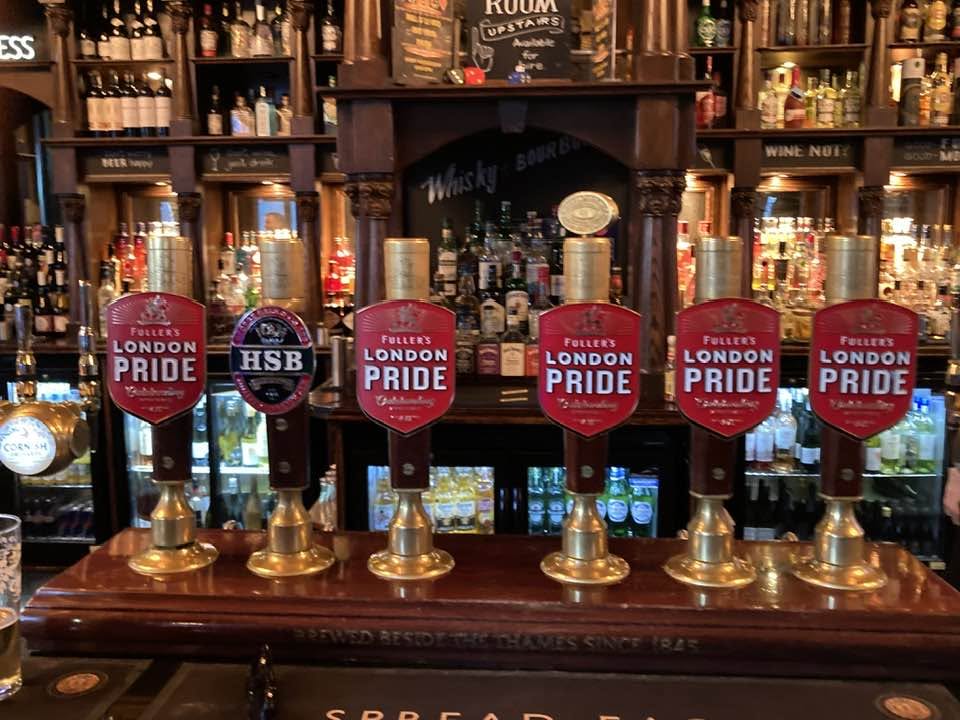
[The performers left the pub, and exited stage right, back towards East Croydon Station].
Epilogue
I found my visit to Croydon surprisingly emotional, not least because it was shared with friends. The emotions arise from the many memories that were evoked by the various places we visited, enhanced by the pooling of our shared and idiosyncratic experiences. However, I think there is another layer to this, something about the inexorable passing of time at an ever-increasing pace and the inevitable changes this brings. I mentioned earlier that I did not expect Croydon to be how I remembered it from more than 20 years ago, and this certainly proved to be the case. But the essential topography of the town remains the same, it just has a different manifestation now. I likened it to the formation of a coral reef – outwardly ever-changing, but the original core remains.
I think the changes we notice in our physical environments have their counterparts in our inner selves. We certainly look different as the years pass, and we may behave differently, but that central part of who we are remains who we always were. I spoke about the common experiences that bound us as friends across the years, growing up in those years when society was rapidly changing, and of our values and beliefs being shaped by the schooling we shared. I can truly say that if I had met Paul, Trev and Rob for the first time this year, I would feel they were the kind of guys I would like as friends. So thank you.
[Final Note – Photographs of some of the places mentioned in this post can be found in my following Flickr albums: Croydon Revisited and Croydon Town Hall.]

